
FRC-830-002 · v0.1
Operational Registers and Reciprocity-Preserving Morphisms v0.1
Reading status
Current statement
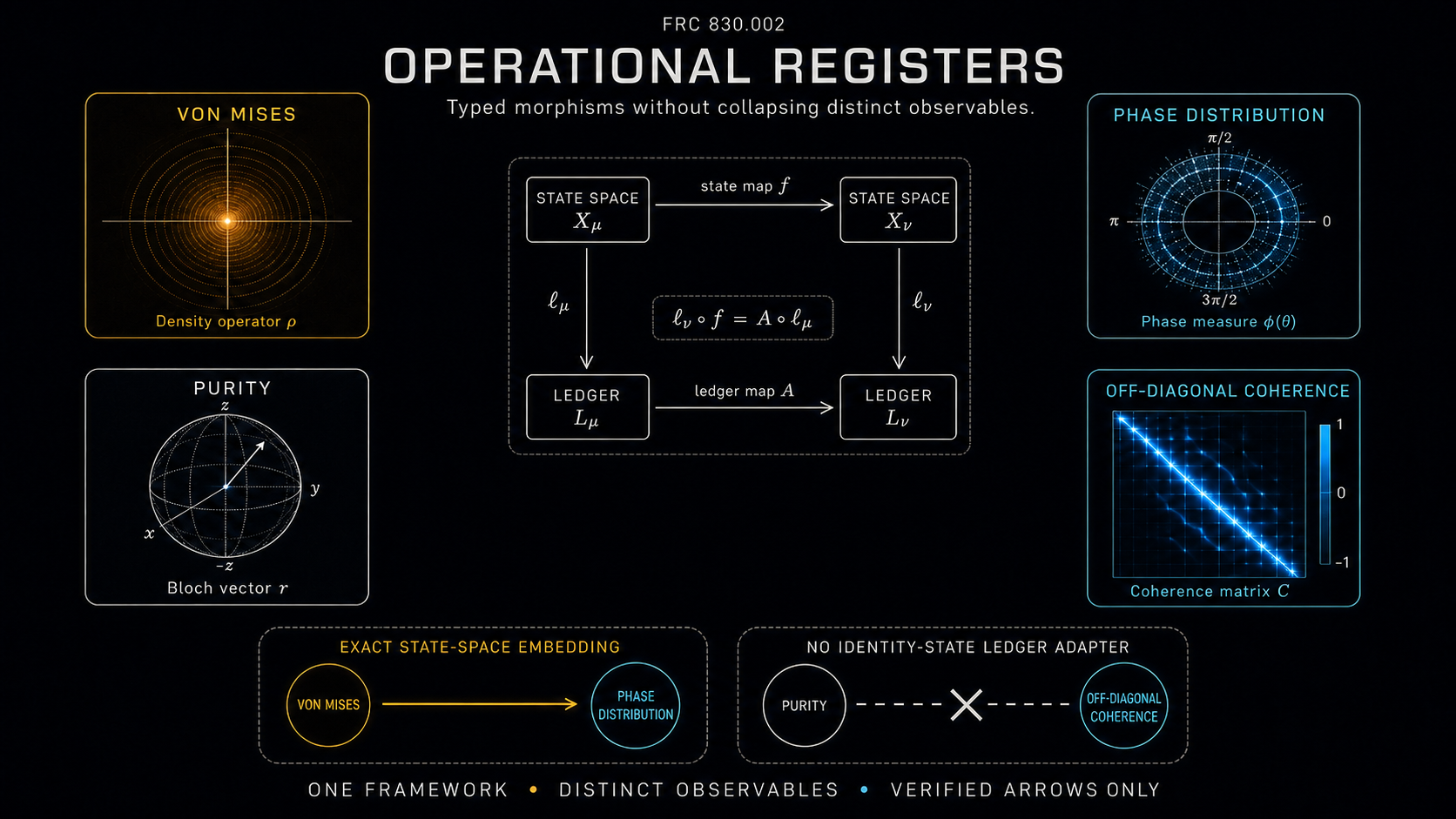
FRC can reuse many successful coherence measures without pretending they are identical. Strong register morphisms must act on states and commute with their ledgers; von Mises embeds exactly into the phase route, while purity cannot be silently converted into off-diagonal coherence under the identity state map.
Evidence level
Frontier preprint
preprint
Declared μ register
μ4 · Logical / conceptual
Logic, formal models, language as explicit reasoning, and computational design.
Open boundary
Review the paper’s declared scope, controls, limitations, and kill conditions.
Version lineage
v0.1 · Current release
On this page
FRC uses several legitimate coherence routes, including phase order, the von Mises mean resultant, quantum purity, basis-dependent off-diagonal interference, and platform-specific composites. This paper formalizes how those routes may share a framework without being declared the same observable. A weak reciprocity map preserves the pulled-back ledger one-form up to a nonzero multiplier. A strong affine register morphism additionally supplies a state or model map and a commuting ledger square. Both classes compose; the strong class forms a category with explicit identities, associativity, exact-preserving and signed subcategories, and an invertible groupoid. One-form preservation alone is shown insufficient by an exact counterexample. The von Mises family supplies a nontrivial strong morphism into the phase-distribution register: the state-space inclusion commutes exactly with the entropy and mean-resultant ledger, but is not an isomorphism. A qubit no-go theorem proves that purity and fixed-basis off-diagonal coherence admit no single-valued ledger adapter under the identity state map, even though both are valid operational routes. Present FRC registers therefore form a typed formal category populated by a sparse graph of verified arrows, not one proven physical equivalence class.