
FRC 840.101: The Phase–Attention Boundary
Reading status
Current statement
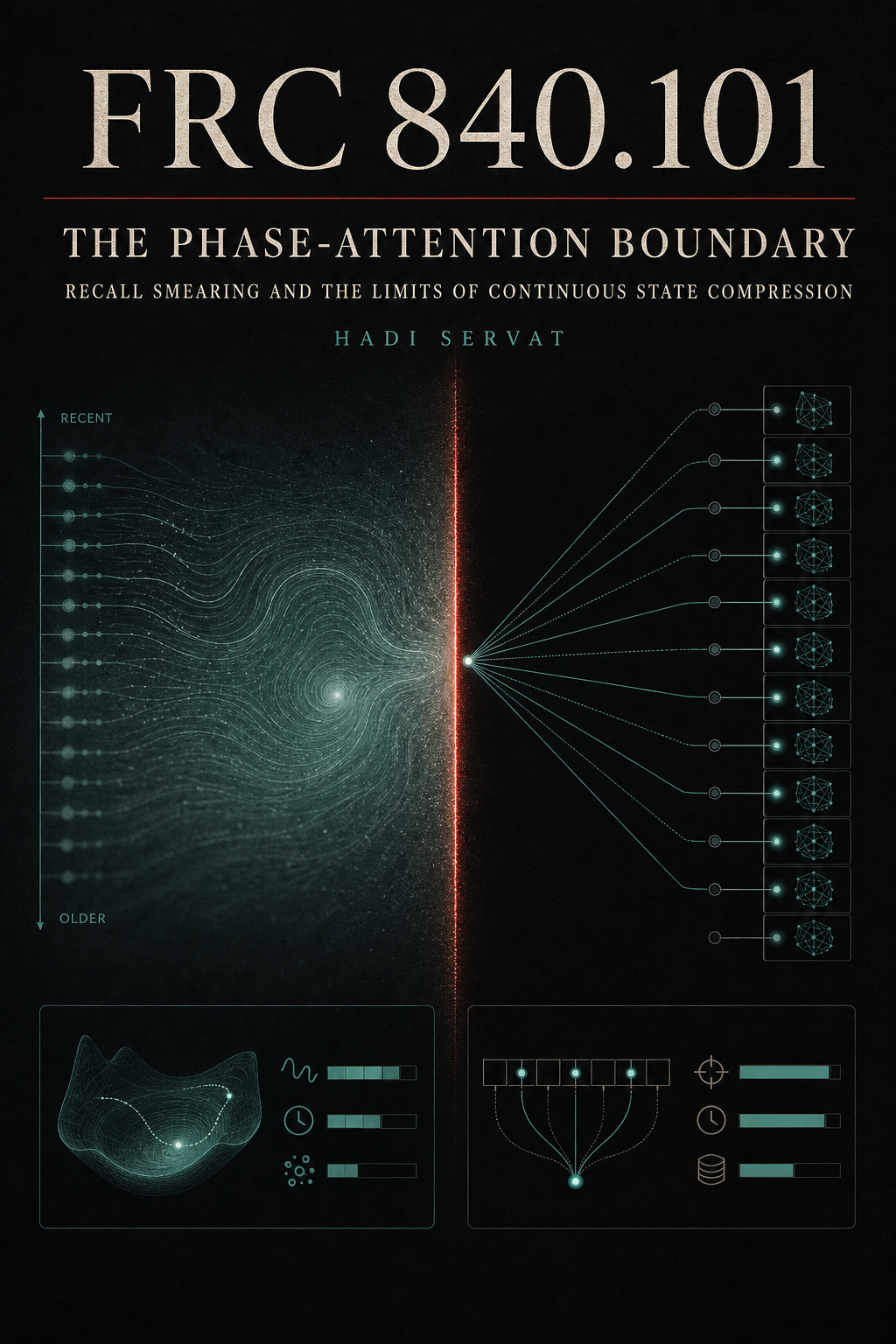
This paper formulates the Phase–Attention Boundary: a structural separation between continuous phase-state architectures and discrete attention-based architectures. Within the Fractal Resonance Cognition (FRC) program, the Large Lambda-Tensor Model (LLTM) was developed as a continuous recurrent phase-coupled architecture inspired by Kuramoto dynamics and low-rank coherence fields. Controlled comparisons against Transformer baselines revealed a fundamental limitation: continuous state compression blends historical information into a finite evolving state, producing recall smearing. We prove a formal Recall Smearing Theorem: under gamma-contractive recurrence, mutual information about a past token decays exponentially with distance. This bound is derived from the Data Processing Inequality and applies universally to fixed-state recurrent systems, including state-space models like S4, Mamba, RWKV, Griffin, and xLSTM. We show that data-dependent selectivity can reduce the rate of smearing but cannot eliminate it; only explicit key-value addressability achieves zero-smearing recall.
Evidence level
Frontier preprint
Declared μ register
μ4 · Logical / conceptual
Logic, formal models, language as explicit reasoning, and computational design.
Open boundary
Review the paper’s declared scope, controls, limitations, and kill conditions.
Version lineage
Current release · Current release
On this page
This paper formulates the Phase–Attention Boundary: a structural separation between continuous phase-state architectures and discrete attention-based architectures. Within the Fractal Resonance Cognition (FRC) program, the Large Lambda-Tensor Model (LLTM) was developed as a continuous recurrent phase-coupled architecture inspired by Kuramoto dynamics and low-rank coherence fields. Controlled comparisons against Transformer baselines revealed a fundamental limitation: continuous state compression blends historical information into a finite evolving state, producing recall smearing. We prove a formal Recall Smearing Theorem: under gamma-contractive recurrence, mutual information about a past token decays exponentially with distance. This bound is derived from the Data Processing Inequality and applies universally to fixed-state recurrent systems, including state-space models like S4, Mamba, RWKV, Griffin, and xLSTM. We show that data-dependent selectivity can reduce the rate of smearing but cannot eliminate it; only explicit key-value addressability achieves zero-smearing recall.